How To Detect AI Writing

How To Detect AI Writing — independent reviews, comparisons, pricing and step-by-step guides on Aizhi.

  • IRows

    IRows

    iRows was a web-based spreadsheet in beta with a GUI similar to the traditional desktop-based spreadsheet applications, such as Microsoft Excel and OpenOffice.org. It was shut down on December 31, 2006, after it was announced that its two founders had been hired by Google. iRows used Ajax and XML. It was described as an example of a Web 2.0 system. iRows supported conventional spreadsheet features functions, value formatting and charts and added web oriented spreadsheet capabilities like collaboration (multiple people using a shared spreadsheet, sending a spreadsheet as a link instead of an attachment and ability to publish spreadsheets on other web pages (e.g. blogs).

    Read more →
  • Avizo (software)

    Avizo (software)

    Avizo (pronounce: 'a-VEE-zo') is a general-purpose commercial software application for scientific and industrial data visualization and analysis. Avizo is developed by Thermo Fisher Scientific and was originally designed and developed by the Visualization and Data Analysis Group at Zuse Institute Berlin (ZIB) under the name Amira. Avizo was commercially released in November 2007. For the history of its development, see the Wikipedia article about Amira. == Overview == Avizo is a software application which enables users to perform interactive visualization and computation on 3D data sets. The Avizo interface is modelled on the visual programming. Users manipulate data and module components, organized in an interactive graph representation (called Pool), or in a Tree view. Data and modules can be interactively connected together, and controlled with several parameters, creating a visual processing network whose output is displayed in a 3D viewer. With this interface, complex data can be interactively explored and analyzed by applying a controlled sequence of computation and display processes resulting in a meaningful visual representation and associated derived data. == Application areas == Avizo has been designed to support different types of applications and workflows from 2D and 3D image data processing to simulations. It is a versatile and customizable visualization tool used in many fields: Scientific visualization Materials Research Tomography, Microscopy, etc. Nondestructive testing, Industrial Inspection, and Visual Inspection Computer-aided Engineering and simulation data post-processing Porous medium analysis Civil Engineering Seismic Exploration, Reservoir Engineering, Microseismic Monitoring, Borehole Imaging Geology, Digital Rock Physics (DRP), Earth Sciences Archaeology Food technology and agricultural science Physics, Chemistry Climatology, Oceanography, Environmental Studies Astrophysics == Features == Data import: 2D and 3D image stack and volume data: from microscopes (electron, optical), X-ray tomography (CT, micro-/nano-CT, synchrotron), neutron tomography and other acquisition devices (MRI, radiography, GPR) Geometric models (such as point sets, line sets, surfaces, grids) Numerical simulation data (such as Computational fluid dynamics or Finite element analysis data) Molecular data Time series and animations Seismic data Well logs 4D Multivariate Climate Models 2D/3D data visualization: Volume rendering Digital Volume Correlation Visualization of sections, through various slicing and clipping methods Isosurface rendering Polygonal meshes Scalar fields, Vector fields, Tensor representations, Flow visualization (Illuminated Streamlines, Stream Ribbons) Image processing: 2D/3D Alignment of image slices, Image registration Image filtering Mathematical Morphology (erode, dilate, open, close, tophat) Watershed Transform, Distance Transform Image segmentation 3D models reconstruction: Polygonal surface generation from segmented objects Generation of tetrahedral grids Surface reconstruction from point clouds Skeletonization (reconstruction of dendritic, porous or fracture network) Surface model simplification Quantification and analysis: Measurements and statistics Analysis spreadsheet and charting Material properties computation, based on 3D images: Absolute permeability Thermal conductivity Molecular diffusivity Electrical resistivity/formation factor 3D image-based meshing for CFD and FEA: From 3D imaging modalities (CT, micro-CT, MRI, etc.) Surface and volume meshes generation Export to FEA and CFD solvers for simulation Post-processing for simulation analysis Presentation, automation: MovieMaker, Multiscreen, Video wall, collaboration, and VR support TCL Scripting, C++ extension API Avizo is based on Open Inventor 3D graphics toolkits (FEI Visualization Sciences Group).

    Read more →
  • ActivTrak

    ActivTrak

    ActivTrak is an American company that produces workforce analytics and productivity software. The company was founded in 2009 by Birch Grove Software and is headquartered in Austin, Texas. The company has raised US$77.5 million in funding and is backed by Sapphire Ventures and Elsewhere Partners. == History == ActivTrak was founded in 2009 by Herb Axilrod and Anton Seidler in Dallas, Texas. ActivTrak's first on-demand software product launched in 2012, and the workforce analytics platform launched in 2015. It uses data sourced from more than 9,500 customers and 900,000 users. In 2019, ActivTrak raised $20 million in a Series A round of funding with Elsewhere Partners, a growth-stage venture capital firm that principally invests in B2B startups. Rita Selvaggi assumed the role of CEO. In 2020, ActivTrak raised $50M in a Series B round of funding with Sapphire Ventures and Elsewhere Partners. The company also introduced the ActivTrak Productivity Lab, an online resource about workforce productivity research, industry benchmark data, and best practices. == Product == ActivTrak is a workforce analytics and productivity platform that uses reports, dashboards, and data analysis. The platform uses machine learning (AI) to collect and analyze user activity data and produce reports about workforce productivity. The software runs on Microsoft Windows, Mac, Chrome, Terminal Services, and VDI. It includes the ActivTrak Agent, which runs in the background and collects data. It responds to user activity, sensing mouse and keyboard movement in the active window(s) of the user's device. This data is collected and stored in a database that aggregates the data based on the user's request. ActivTrak does not utilize keystroke logging, content scraping, camera access, video recording or mobile device monitoring. The database leverages data analytics to generate account and team benchmarks, and identify productivity patterns and outliers. == Awards == Built In, 100 Best Midsize Places to Work in Austin, 2025 G2, Winter: Best Estimated ROI, High Performer, Best Relationship, Best Support, Users Most Likely to Recommend, Easiest Setup, Easiest Admin, Best Meets Requirements, Users Love Us, 2025 TrustRadius, Buyer’s Choice, 2025 Deloitte Technology Fast 500, No. 468 Fastest-Growing Company, 2024 Product Marketing Alliance, AI Marketing Innovation, 2024 Fortune Best Workplaces in Technology™, 2024 Inc. 5000, No. 2335 of America’s Fastest-Growing Private Companies, 2024 Fortune Best Workplaces in Texas™, 2024 Reworked IMPACT Gold Award: Most Innovative Workplace Productivity Solution, 2024 TrustRadius, Most Loved, 2024 Great Place To Work-Certified™, 2024 Inc. 5000 Regionals: Southwest, 2024 Brandon Hall Group, Best Advance in HR Predictive Analytics Technology, 2024

    Read more →
  • Video renderer

    Video renderer

    A video renderer is software that processes a video file and sends it sequentially to the video display controller card for display on a computer screen. An example of a video renderer, is the VMR-7 that was used by Microsoft's DirectShow. An example of a UNIX video renderer is the one container within GStreamer. Commonly used video renderers are: Enhanced Video Renderer VMR9 Renderless Haali's Video Renderer Madvr Video Renderer JRVR, a part of JRiver Media Center

    Read more →
  • Database-as-IPC

    Database-as-IPC

    In computer programming, Database-as-IPC may be considered an anti-pattern where a disk persisted table in a database is used as the message queue store for routine inter-process communication (IPC) or subscribed data processing. If database performance is of concern, alternatives include sockets, network socket, or message queue. British computer scientist, Junade Ali, defined the Database-as-IPC Anti-Pattern as using a database to "schedule jobs or queue up tasks to be completed", noting that this anti-pattern centres around using a database for temporary messages instead of persistent data. == Controversy == The issue arises if there is a performance issue, and if additional systems (and servers) can be justified. In terms of performance, recent advancements in database systems provide more efficient mechanisms for signaling and messaging, and database systems also support memory (non-persisted) tables. There are databases with built-in notification mechanisms, such as PostgreSQL, SQL Server, and Oracle. These mechanisms and future improvements of database systems can make queuing much more efficient and avoid the need to set up a separate signaling or messaging queue system along with the server and management overhead. While MySQL doesn't have direct support for notifications, some workarounds are possible. However, they would be seen as non-standard and therefore more difficult to maintain.

    Read more →
  • Figure AI

    Figure AI

    Figure AI, Inc. is an American robotics company developing humanoid robots that operate via artificial intelligence. The company was founded in 2022 by Brett Adcock. As of late 2025, the company has a $39 billion valuation. Three generations of humanoid robots (Figure 01–03) have been developed, as well as two iterations of a vision-language-action model (Helix 01–02), which can control up to two robots at once. By 2026, the robots demonstrated the potential ability to perform household work and the company gained publicity when a Figure 03 appeared at a White House event. == History == Figure AI was founded in 2022 by Brett Adcock, also known for founding Archer Aviation and Vettery. That year, the company introduced its prototype, Figure 01, a bipedal robot designed for manual labor, initially targeting the logistics and warehousing sectors. The initial model utilized external cabling for easier maintenance. In May 2023, Figure AI raised $70 million from investors including Adcock, who invested $20 million, and Parkway Venture Capital. In January 2024, Figure AI announced a partnership with BMW to deploy humanoid robots in automotive manufacturing facilities. In February 2024, Figure AI secured $675 million in venture capital funding from a consortium that includes Jeff Bezos, Microsoft, Nvidia, Intel, and the startup-funding divisions of Amazon and OpenAI; the company was then valued at $2.6 billion. Figure AI also announced a partnership with OpenAI, which would build specialized artificial intelligence (AI) models for Figure AI's humanoid robots, enabling its robots to process language; the collaboration ended after a year, with Adcock stating that large language models had become a smaller problem compared to those allowing for "high rate robot control". In August 2024, the company introduced Figure 02, describing it as the next step toward deploying humanoids for industrial use. The machine has 35 degrees of freedom (DOF), while the five-fingered hands have 16 DOF and the ability to carry up to 25 kilograms (55 lb). The model is equipped with cabling integrated into the limbs, a torso-placed battery, six RGB cameras, and an onboard vision-language-action (VLA) model. It has three times the computing power (including inference AI) of the previous model, including two graphics processing units, supported by Nvidia. Microphones, speakers, and custom AI models (developed with OpenAI) enable communication with humans. In early 2025, Figure AI announced BotQ, a manufacturing facility aiming to produce 12,000 humanoids per year with the help of its own humanoid robots, and Helix, a VLA model that can control up to two robots at once. Helix enables a robot to interact with the world without extensive manual training, according to the company allowing it to pick up nearly any small household object. By April, the company issued cease-and-desist letters to at least two secondary brokers promoting its private stock without authorization. In September, a third round of financing exceeded $1 billion, raising the company's total valuation to $39 billion. Investors included Brookfield Asset Management, Intel, Macquarie Capital, Nvidia, Parkway Venture Capital, Qualcomm, Salesforce, and T-Mobile. In October 2025, Figure 03 was introduced. According to the company, its hardware and software redesign aims to create a general-purpose robot able to learn directly from humans. An upgraded camera system delivers twice the frame rate, a quarter the latency, and a 60% wider field of view, in addition to a camera in each hand. Tactile sensors in the fingertips can detect forces as little as 3 grams (0.1 oz). It incorporates soft materials and a protected battery for safety, and removable, washable textiles. It supports wireless inductive charging. In November 2025, the former head of product safety sued the company on the basis of being fired for raising the concern that the company's robots were strong enough to fracture a human skull. By early 2026, Figure 02 had been used in demonstrations showing that it could load a washing machine, sort packages, and fold laundry. That January, Helix 02 was released, expanding the AI model to the entire body to allow for functional autonomy. A Helix 02–powered Figure 02 was shown to be capable of loading and unloading a dishwasher, based on hours of motion-capture data and simulation-based machine learning. In March, U.S. First Lady Melania Trump appeared at the White House with a Figure 03, promoting the presumptive eventual ability of AI to teach children. In May 2026, Figure AI livestreamed a group of their robots processing packages nonstop for almost a week, inspiring a 10-hour competition between their robot and a human, in which the robot performed 98.5% as well as the human.

    Read more →
  • Optical sorting

    Optical sorting

    Optical sorting (sometimes called digital sorting) is the automated process of sorting solid products using cameras and/or lasers. Depending on the types of sensors used and the software-driven intelligence of the image processing system, optical sorters can recognize an object's color, size, shape, structural properties and chemical composition. The sorter compares objects to user-defined accept/reject criteria to identify and remove defective products and foreign material (FM) from the production line, or to separate product of different grades or types of materials. Optical sorters are in widespread use in the food industry worldwide, with the highest adoption in processing harvested foods such as potatoes, fruits, vegetables and nuts where it achieves non-destructive, 100 percent inspection in-line at full production volumes. The technology is also used in pharmaceutical manufacturing and nutraceutical manufacturing, tobacco processing, waste recycling and other industries. Compared to manual sorting, which is subjective and inconsistent, optical sorting helps improve product quality, maximize throughput and increase yields while reducing labor costs. == History == Optical sorting is an idea that first came out of the desire to automate industrial sorting of agricultural goods like fruits and vegetables. Before automated optical sorting technology was conceived in the 1930s, companies like Unitec were producing wooden machinery to assist in the mechanical sorting of fruit processing. In 1931, a company known as “the Electric Sorting Company” was incorporated and began the creation of the world’s first color sorters, which were being installed and used in Michigan’s bean industry by 1932. In 1937, optical sorting technology had advanced to allow for systems based on a two-color principle of selection. The next few decades saw the installation of new and improved sorting mechanisms, like gravity feed systems and the implementation of optical sorting in more agricultural industries. In the late 1960s, optical sorting began to be implemented to new industries beyond agriculture, like the sorting of ferrous and non-ferrous metals. By the 1990s, optical sorting was being used heavily in the sorting of solid wastes. With the large technological revolution happening in the late 1990s and early 2000s, optical sorters were being made more efficient via the implementation of new optical sensors, like CCD, UV, and IR cameras. Today, optical sorting is used in a wide variety of industries and, as such, is implemented with a varying selection of mechanisms to assist in that specific sorter’s task. == The sorting system == In general, optical sorters feature four major components: the feed system, the optical system, image processing software, and the separation system. The objective of the feed system is to spread products into a uniform monolayer so products are presented to the optical system evenly, without clumps, at a constant velocity. The optical system includes lights and sensors housed above and/or below the flow of the objects being inspected. The image processing system compares objects to user-defined accept/reject thresholds to classify objects and actuate the separation system. The separation system — usually compressed air for small products and mechanical devices for larger products, like whole potatoes — pinpoints objects while in-air and deflects the objects to remove into a reject chute while the good product continues along its normal trajectory. The ideal sorter to use depends on the application. Therefore, the product's characteristics and the user's objectives determine the ideal sensors, software-driven capabilities and mechanical platform. == Sensors == Optical sorters require a combination of lights and sensors to illuminate and capture images of the objects so the images can be processed. The processed images will determine if the material should be accepted or rejected. There are camera sorters, laser sorters and sorters that feature a combination of the two on one platform. Lights, cameras, lasers and laser sensors can be designed to function within visible light wavelengths as well as the infrared (IR) and ultraviolet (UV) spectrums. The optimal wavelengths for each application maximize the contrast between the objects to be separated. Cameras and laser sensors can differ in spatial resolution, with higher resolutions enabling the sorter to detect and remove smaller defects. === Cameras === Monochromatic cameras detect shades of gray from black to white and can be effective when sorting products with high-contrast defects. Sophisticated color cameras with high color resolution are capable of detecting millions of colors to better distinguish more subtle color defects. Trichromatic color cameras (also called three-channel cameras) divide light into three bands, which can include red, green and/or blue within the visible spectrum as well as IR and UV. The interaction of different materials with parts of the electromagnetic spectrum make these contrasts more evident than how they appear to the naked human eye. Coupled with intelligent software, sorters that feature cameras are capable of recognizing each object's color, size and shape; as well as the color, size, shape and location of a defect on a product. Some intelligent sorters even allow the user to define a defective product based on the total defective surface area of any given object. === Lasers === While cameras capture product information based primarily on material reflectance, lasers and their sensors are able to distinguish a material's structural properties along with their color. This structural property inspection allows lasers to detect a wide range of organic and inorganic foreign material such as insects, glass, metal, sticks, rocks and plastic; even if they are the same color as the good product. Lasers can be designed to operate within specific wavelengths of light; whether on the visible spectrum or beyond. For example, lasers can detect chlorophyll by stimulating fluorescence using specific wavelengths; which is a process that is very effective for removing foreign material from green vegetables. === Camera/laser combinations === Sorters equipped with cameras and lasers on one platform are generally capable of identifying the widest variety of attributes. Cameras are often better at recognizing color, size and shape while laser sensors identify differences in structural properties to maximize foreign material detection and removal. === Hyperspectral Imaging === Driven by the need to solve previously impossible sorting challenges, a new generation of sorters that feature multispectral and hyperspectral imaging Optical Sorters. Like trichromatic cameras, multispectral and hyperspectral cameras collect data from the electromagnetic spectrum. Unlike trichromatic cameras, which divide light into three bands, hyperspectral systems can divide light into hundreds of narrow bands over a continuous range that covers a vast portion of the electromagnetic spectrum. This opens the door for more detailed analysis that leads to a more consistent product. Using IR alone might detect some defects, but combining it with a broader range of the spectrum makes it more effective. Compared to the three data points per pixel collected by trichromatic cameras, hyperspectral cameras can collect hundreds of data points per pixel, which are combined to create a unique spectral signature (also called a fingerprint) for each object. When complemented by capable software intelligence, a hyperspectral sorter processes those fingerprints to enable sorting on the chemical composition of the product. This is an emerging area of chemometrics. == Software-driven intelligence == Once the sensors capture the object's response to the energy source, image processing is used to manipulate the raw data. The image processing extracts and categorizes information about specific features. The user then defines accept/reject thresholds that are used to determine what is good and bad in the raw data flow. The art and science of image processing lies in developing algorithms that maximize the effectiveness of the sorter while presenting a simple user-interface to the operator. Object-based recognition is a classic example of software-driven intelligence. It allows the user to define a defective product based on where a defect lies on the product and/or the total defective surface area of an object. It offers more control in defining a wider range of defective products. When used to control the sorter's ejection system, it can improve the accuracy of ejecting defective products. This improves product quality and increases yields. New software-driven capabilities are constantly being developed to address the specific needs of various applications. As computing hardware becomes more powerful, new software-driven advancements become possible. Some of these advancements enhance the effectivene

    Read more →
  • Evolutionary robotics

    Evolutionary robotics

    Evolutionary robotics is an embodied approach to Artificial Intelligence (AI) in which robots are automatically designed using Darwinian principles of natural selection. The design of a robot, or a subsystem of a robot such as a neural controller, is optimized against a behavioral goal (e.g. run as fast as possible). Usually, designs are evaluated in simulations as fabricating thousands or millions of designs and testing them in the real world is prohibitively expensive in terms of time, money, and safety. An evolutionary robotics experiment starts with a population of randomly generated robot designs. The worst performing designs are discarded and replaced with mutations and/or combinations of the better designs. This evolutionary algorithm continues until a prespecified amount of time elapses or some target performance metric is surpassed. Evolutionary robotics methods are particularly useful for engineering machines that must operate in environments in which humans have limited intuition (nanoscale, space, etc.). Evolved simulated robots can also be used as scientific tools to generate new hypotheses in biology and cognitive science, and to test old hypothesis that require experiments that have proven difficult or impossible to carry out in reality. == History == In the early 1990s, two separate European groups demonstrated different approaches to the evolution of robot control systems. Dario Floreano and Francesco Mondada at EPFL evolved controllers for the Khepera robot. Adrian Thompson, Nick Jakobi, Dave Cliff, Inman Harvey, and Phil Husbands evolved controllers for a Gantry robot at the University of Sussex. However the body of these robots was presupposed before evolution. The first simulations of evolved robots were reported by Karl Sims and Jeffrey Ventrella of the MIT Media Lab, also in the early 1990s. However these so-called virtual creatures never left their simulated worlds. The first evolved robots to be built in reality were 3D-printed by Hod Lipson and Jordan Pollack at Brandeis University at the turn of the 21st century.

    Read more →
  • Quantum image processing

    Quantum image processing

    Quantum image processing (QIMP) is using quantum computing or quantum information processing to create and work with quantum images. Due to some of the properties inherent to quantum computation, notably entanglement and parallelism, it is hoped that QIMP technologies will offer capabilities and performances that surpass their traditional equivalents, in terms of computing speed, security, and minimum storage requirements. == Background == A. Y. Vlasov's work in 1997 focused on using a quantum system to recognize orthogonal images. This was followed by efforts using quantum algorithms to search specific patterns in binary images and detect the posture of certain targets. Notably, more optics-based interpretations for quantum imaging were initially experimentally demonstrated in and formalized in after seven years. In 2003, Salvador Venegas-Andraca and S. Bose presented Qubit Lattice, the first published general model for storing, processing and retrieving images using quantum systems. Later on, in 2005, Latorre proposed another kind of representation, called the Real Ket, whose purpose was to encode quantum images as a basis for further applications in QIMP. Furthermore, in 2010 Venegas-Andraca and Ball presented a method for storing and retrieving binary geometrical shapes in quantum mechanical systems in which it is shown that maximally entangled qubits can be used to reconstruct images without using any additional information. Technically, these pioneering efforts with the subsequent studies related to them can be classified into three main groups: Quantum-assisted digital image processing (QDIP): These applications aim at improving digital or classical image processing tasks and applications. Optics-based quantum imaging (OQI) Classically inspired quantum image processing (QIMP) A survey of quantum image representation has been published in. Furthermore, the recently published book Quantum Image Processing provides a comprehensive introduction to quantum image processing, which focuses on extending conventional image processing tasks to the quantum computing frameworks. It summarizes the available quantum image representations and their operations, reviews the possible quantum image applications and their implementation, and discusses the open questions and future development trends. == Quantum image representations == There are various approaches for quantum image representation, that are usually based on the encoding of color information. A common representation is FRQI (Flexible Representation for Quantum Images), that captures the color and position at every pixel of the image, and defined as: | I ⟩ = 1 2 n ∑ i = 0 2 2 n − 1 | c i ⟩ ⊗ | i ⟩ {\displaystyle \vert I\rangle ={\frac {1}{2^{n}}}\sum _{i=0}^{2^{2n-1}}\vert c_{i}\rangle \otimes \vert i\rangle } where | i ⟩ {\textstyle |i\rangle } is the position and | c i ⟩ = c o s θ i | 0 ⟩ + s i n θ i | 1 ⟩ {\textstyle \vert c_{i}\rangle =cos\theta _{i}\vert 0\rangle +sin\theta _{i}\vert 1\rangle } the color with a vector of angles θ i ∈ [ 0 , π / 2 ] {\textstyle \theta _{i}\in \left[0,\pi /2\right]} . As it can be seen, | c i ⟩ {\textstyle \vert c_{i}\rangle } is a regular qubit state of the form | ψ ⟩ = α | 0 ⟩ + β | 1 ⟩ {\displaystyle \vert \psi \rangle =\alpha \vert 0\rangle +\beta \vert 1\rangle } , with basis states | 0 ⟩ = ( 1 0 ) {\textstyle \vert 0\rangle ={\begin{pmatrix}1\\0\end{pmatrix}}} and | 1 ⟩ = ( 0 1 ) {\textstyle \vert 1\rangle ={\begin{pmatrix}0\\1\end{pmatrix}}} , as well as amplitudes α {\textstyle \alpha } and β {\textstyle \beta } that satisfy | α | 2 + | β | 2 = 1 {\textstyle \left|\alpha \right|^{2}+\left|\beta \right|^{2}=1} . Another common representation is MCQI (Multi-Channel Representation for Quantum Images), that uses the RGB channels with quantum states and following FRQI definition: | I ⟩ = 1 2 n + 1 ∑ i = 0 2 2 n − 1 | C R G B i ⟩ ⊗ | i ⟩ {\displaystyle \vert I\rangle ={\frac {1}{2^{n+1}}}\sum _{i=0}^{2^{2n-1}}\vert C_{RGB}^{i}\rangle \otimes \vert i\rangle } | C R G B i ⟩ = cos ⁡ θ R i | 000 ⟩ + cos ⁡ θ G i | 001 ⟩ + cos ⁡ θ B i | 010 ⟩ + sin ⁡ θ R i | 100 ⟩ + sin ⁡ θ G i | 101 ⟩ + sin ⁡ θ B i | 110 ⟩ + cos ⁡ θ α | 011 ⟩ + sin ⁡ θ α | 111 ⟩ {\displaystyle {\begin{aligned}{\begin{aligned}\vert C_{RGB}^{i}\rangle &={\cos \theta _{R}^{i}\vert 000\rangle }+{\cos \theta _{G}^{i}\vert 001\rangle }+{\cos \theta _{B}^{i}\vert 010\rangle }\\&\quad +{\sin \theta _{R}^{i}\vert 100\rangle }+{\sin \theta _{G}^{i}\vert 101\rangle }+{\sin \theta _{B}^{i}\vert 110\rangle }\\&\quad +{\cos {\theta _{\alpha }}\vert 011\rangle }+{\sin \theta _{\alpha }\vert 111\rangle }\end{aligned}}\end{aligned}}} Departing from the angle-based approach of FRQI and MCQI, and using a qubit sequence, NEQR (Novel Enhanced Representation for Quantum Images) is another representation approach, that uses a function f ( y , x ) = C y x q − 1 C y x q − 2 … C y x 1 C y x 0 {\textstyle f\left(y,x\right)=C_{yx}^{q-1}C_{yx}^{q-2}\ldots C_{yx}^{1}C_{yx}^{0}} to encode color values for a 2 n × 2 n {\displaystyle 2^{n}\times 2^{n}} image: | I ⟩ = 1 2 n ∑ y = 0 2 n − 1 ∑ x = 0 2 n − 1 | f ( y , x ) ⟩ | y x ⟩ {\displaystyle \vert I\rangle ={\frac {1}{2^{n}}}\sum _{y=0}^{2^{n}-1}\sum _{x=0}^{2^{n}-1}\vert f\left(y,x\right)\rangle \vert yx\rangle } == Quantum image manipulations == A lot of the effort in QIMP has been focused on designing algorithms to manipulate the position and color information encoded using flexible representation of quantum images (FRQI) and its many variants. For instance, FRQI-based fast geometric transformations including (two-point) swapping, flip, (orthogonal) rotations and restricted geometric transformations to constrain these operations to a specified area of an image were initially proposed. Recently, NEQR-based quantum image translation to map the position of each picture element in an input image into a new position in an output image and quantum image scaling to resize a quantum image were discussed. While FRQI-based general form of color transformations were first proposed by means of the single qubit gates such as X, Z, and H gates. Later, Multi-Channel Quantum Image-based channel of interest (CoI) operator to entail shifting the grayscale value of the preselected color channel and the channel swapping (CS) operator to swap the grayscale values between two channels have been fully discussed. To illustrate the feasibility and capability of QIMP algorithms and application, researchers always prefer to simulate the digital image processing tasks on the basis of the QIRs that we already have. By using the basic quantum gates and the aforementioned operations, so far, researchers have contributed to quantum image feature extraction, quantum image segmentation, quantum image morphology, quantum image comparison, quantum image filtering, quantum image classification, quantum image stabilization, among others. In particular, QIMP-based security technologies have attracted extensive interest of researchers as presented in the ensuing discussions. Similarly, these advancements have led to many applications in the areas of watermarking, encryption, and steganography etc., which form the core security technologies highlighted in this area. In general, the work pursued by the researchers in this area are focused on expanding the applicability of QIMP to realize more classical-like digital image processing algorithms; propose technologies to physically realize the QIMP hardware; or simply to note the likely challenges that could impede the realization of some QIMP protocols. == Quantum image transform == By encoding and processing the image information in quantum-mechanical systems, a framework of quantum image processing is presented, where a pure quantum state encodes the image information: to encode the pixel values in the probability amplitudes and the pixel positions in the computational basis states. Given an image F = ( F i , j ) M × L {\displaystyle F=(F_{i,j})_{M\times L}} , where F i , j {\displaystyle F_{i,j}} represents the pixel value at position ( i , j ) {\displaystyle (i,j)} with i = 1 , … , M {\displaystyle i=1,\dots ,M} and j = 1 , … , L {\displaystyle j=1,\dots ,L} , a vector f → {\displaystyle {\vec {f}}} with M L {\displaystyle ML} elements can be formed by letting the first M {\displaystyle M} elements of f → {\displaystyle {\vec {f}}} be the first column of F {\displaystyle F} , the next M {\displaystyle M} elements the second column, etc. A large class of image operations is linear, e.g., unitary transformations, convolutions, and linear filtering. In the quantum computing, the linear transformation can be represented as | g ⟩ = U ^ | f ⟩ {\displaystyle |g\rangle ={\hat {U}}|f\rangle } with the input image state | f ⟩ {\displaystyle |f\rangle } and the output image state | g ⟩ {\displaystyle |g\rangle } . A unitary transformation can be implemented as a unitary evolution. Some basic and commonly used image transforms (e.g., the Fourier, Hadamard, an

    Read more →
  • ALL-IN-1

    ALL-IN-1

    ALL-IN-1 was an office automation product developed and sold by Digital Equipment Corporation in the 1980s. It was one of the first purchasable off the shelf electronic mail products. It was later known as Office Server V3.2 for OpenVMS Alpha and OpenVMS VAX systems before being discontinued. == Overview == ALL-IN-1 was advertised as an office automation system including functionality in Electronic Messaging, Word Processing and Time Management. It offered an application development platform and customization capabilities that ranged from scripting to code-level integration. ALL-IN-1 was designed and developed by Skip Walter, John Churin and Marty Skinner from Digital Equipment Corporation who began work in 1977. Sheila Chance was hired as the software engineering manager in 1981. The first version of the software, called CP/OSS, the Charlotte Package of Office System Services, named after the location of the developers, was released in May 1982. In 1983, the product was renamed ALL-IN-1 and the Charlotte group continued to develop versions 1.1 through 1.3. Digital then made the decision to move most of the development activity to its central engineering facility in Reading, United Kingdom, where a group there took responsibility for the product from version 2.0 (released in field test in 1984 and to customers in 1985) onward. The Charlotte group continued to work on the Time Management subsystem until version 2.3 and other contributions were made from groups based in Sophia Antipolis, France (System for Customization Management and the integration with VAX Notes), Reading (Message Router and MAILbus), and Nashua, New Hampshire (FMS). ALL-IN-1 V3.0 introduced shared file cabinets and the File Cabinet Server (FCS) to lay the foundation for an eventual integration with TeamLinks, Digital's PC office client. Previous integrations with PCs included PC ALL-IN-1, a DOS-based product introduced in 1989 that never proved popular with customers. Bob Wyman was the first product manager. He oversaw the growth of the product culminating in over $2 billion per year in revenue and market leadership in the proprietary office automation sector. Other consultants from Digital Equipment Corporation involved include Frank Nicodem, Donald Vickers and Tony Redmond.

    Read more →
  • Vegas Pro

    Vegas Pro

    Vegas Pro (formerly known as Sony Vegas) is a professional video editing software package for non-linear editing (NLE), designed to run on the Microsoft Windows operating system. The first release of Vegas Beta was on June 11, 1999. Vegas was originally developed as a non-linear audio editing application. Version 2.0 would split the program into audio and video editing variants, with the former being dropped by version 4.0, making the video offering the only variant available to consumers. Vegas Pro features real-time multi-track video and audio editing on unlimited tracks, resolution-independent video sequencing, complex effects, compositing tools, 24-bit/192 kHz audio support, VST and DirectX plug-in effect support, and Dolby Digital surround sound mixing. The software was originally published by Sonic Foundry until May 2003, when Sony purchased Sonic Foundry and formed Sony Creative Software. On May 24, 2016, Sony announced that Vegas was sold to MAGIX, which formed VEGAS Creative Software, to continue support and development of the software. As of the end of March 2026, it was publicly announced that Boris FX had taken ownership of Vegas Pro. Each release of Vegas is sold standalone; however, upgrade discounts are sometimes provided. == Features == Vegas does not require any specialized hardware to run properly, allowing it to operate on any Windows computer that meets the system requirements. == History == Vegas 1.0 was released after a brief public beta by Sonic Foundry on July 23, 1999 at the NAMM Show in Nashville, Tennessee as an audio-only tool with a particular focus on re-scaling and resampling audio. It supported formats like DivX and Real Networks RealSystem G2 file formats. Martin Walker from Sound on Sound described working in Vegas 1.0 as a "very pleasurable experience, especially since so many functions are highly intuitive" though also criticizing some features as hard to figure out due to the lack of a central help file. Later, on June 12, 2000, Vegas Video and Audio 2.0 (also referred to as just Vegas 2.0) was released, with its beta releasing earlier that year on April 10. This was the first version of Vegas to include video-editing tools and was also the first to have a low-cost "LE" version alongside the regular release. The LE releases would continue through version 3.0 of Vegas but would be discontinued by the release of Vegas 4.0. Vegas 3.0 was released the next year on December 3, and added new video effects, features for ease-of-use with DV, and support for editing Windows Media files. Vegas 4.0 was released on 6 February 2003 and added application scripting, advanced color correction, 5.1 surround sound mixing, and Steinberg ASIO support. This was the last release under the Sonic Foundry name after it sold much of its software suite, including Sound Forge and Acid Pro, to Sony Pictures Digital for $18 million later in 2003. Under Sony's ownership, Vegas 5.0 was released on April 19, 2004, bringing 3D track motion, compositing, reversing, envelope automation, etc. 7.0 also added an improved video preview, enhanced layout management, improved snapping, and more customization. With the release of 8.0, Sony opted to go back to the original "Vegas Pro" branding that the first version released with. It added the ability to burn Blu-ray and DVD optical media, support for 32-bit floating point audio, support for tempo-based audio effects, and more. It also moved the timeline to the bottom of the window by default with the option of moving it back to the top if the user wished to. Sony was also experimenting with 64-bit at this time and ported Vegas Pro 8.0 to 64-bit systems under the name "Vegas Pro 8.1". Vegas Pro 9.0 added support for 4K resolution and pro camcorder formats like Red and XDCAM EX. In 2009, Sony Creative Software purchased the Velvetmatter Radiance suite of video FX plug-ins which were included in Sony Vegas Pro 9.0. As a result, they were no longer available as a separate product from Velvetmatter. Vegas Pro 10 was released in 2010 with stereoscopic 3D editing, image stabilization, OpenFX plugin support, real-time audio event effects, and a few UI changes. This was the last release to include support for Windows XP. Vegas Pro 11 was released the next year on 17 October, with GPGPU video acceleration, enhanced text tools, enhanced stereoscopic/3D features, RAW photo support, and new event synchronization mechanisms. In addition, Vegas Pro 11 comes pre-loaded with "NewBlue" Titler Pro, a 2D and 3D titling plug-in. Vegas Pro 12 would add two new configurations: Vegas Pro 12 Edit, for "Professional Video and Audio Production"; and Vegas Pro 12 Suite, for "Professional Editing, Disc Authoring, and Visual Effects Design". Vegas Pro 13 would be the last version released with Sony branding after the acquisition of much of Sony Creative Software's library by Magix. After they acquired Vegas, Magix released version 14 on September 20, 2016. It featured advanced 4K upscaling as well as many bug fixes, a higher video velocity limit, RED camera support, and a variety of other features. This was also the last version to have the light theme enabled by default. Released on August 28, 2017, Vegas Pro 15 features major UI changes that claim to bring usability improvements and customization. It was the first version of VEGAS Pro to have a dark theme; it also allows more efficient editing speeds, including adding new shortcuts to speed the video editing process. Vegas Pro 15 includes support for Intel Quick Sync Video (QSV) and other technologies, as well as various other features. It introduced a new VEGAS Pro icon as a V. Vegas Pro 16 has some new features including file backup, motion tracking, improved video stabilization, 360° editing and HDR support. Magix has continued to improve Vegas through version 21 with support for reading Matroska files, a more detailed render dialogue, live streaming, VST3 support, a VST 32-bit bridge, and a selective Paste Event Attributes menu. Magix would later release a subscription model for using Vegas named "Vegas Pro 365" on January 17, 2018, although the perpetual licence is still an option for customers. This version includes cloud-based speech synthesis among other features not included in the mainline Vegas release. == Version history == Each release of Vegas is sold standalone, however upgrade discounts are sometimes provided. === Vegas Beta === Sonic Foundry introduced a sneak preview version of Vegas Pro on June 11, 1999. It is called a "Multitrack Media Editing System". === Vegas 1.0 === Released on July 23, 1999 at the NAMM Show in Nashville, Tennessee, Vegas was an audio-only tool with a particular focus on rescaling and resampling audio. It supported formats like DivX and Real Networks RealSystem G2 file formats. Version 1.0 is the final Vegas release to include Windows 95 support. === Vegas Video beta (Vegas 2.0 beta) === Released on April 10, 2000, this was the first version of Vegas to include video-editing tools. === Vegas Video (Vegas 2.0) === Released on June 12, 2000. Version 2.0 is the final Vegas Video release to include Windows NT 4.0 support. === Vegas Video 3.0 === Released on December 3, 2001. This release added: New Video Effects – Lens Flare, Light Rays, Film FX, Color Curves, Mirror, Remap, Deform, Convolution, Linear Blur, Black Restore, Levels, Unsharp Mask, Color Grading, and Timecode Burn filter. Batch Capture with Automatic Scene Detection – Captures DV with automatic scene detection, batch capture, tape logging, still image capture and thumbnail previews. Red Book Audio CD Mastering with CD Architect (TM) Technology – Used for burning Red Book audio CD masters directly from the Vegas timeline with ISRC, UPC, and PQ list support. New Sonic Foundry DV Codec – Introduces a DV codec developed by Sonic Foundry that offers artifact-free compositing and DV chromakeying. DV Print-to-Tape from the Timeline – Prints projects to DV cameras and decks from the Vegas timeline. Windows Media (TM) File Editing – Creates and edits Windows Media (TM) files. New MPEG Encoding Tools – Used for producing MPEG-2 files for DVD productions. Dynamic RAM Previewing – Temporary RAM/render-free previews for analysis and tweaking of complex video FX without rendering. VideoCD and Data CD Burning – Burning projects directly to VideoCD for playback on most DVD players or data CDs for playback computers' CD-ROMs. === Vegas 4.0 === Released on February 6, 2003. This release added: Advanced Color Correction Tools Searchable Media Pool Bins Vectorscope, Histogram, Parade and Waveform Monitoring Application Scripting Improved Ripple Editing Motion Blur and Super-Sampling Envelopes 5.1 Surround Mixing Dolby® Digital AC-3 Encoding certified and tested by Dolby Laboratories DirectX® Audio Plug-In Effects Automation ASIO Driver Support Windows Media™ 9 Support, including Surround Encoding DVD Authoring with AC-3 File Import Capabilities Integration with DVD Architect via Chap

    Read more →
  • Perceptual robotics

    Perceptual robotics

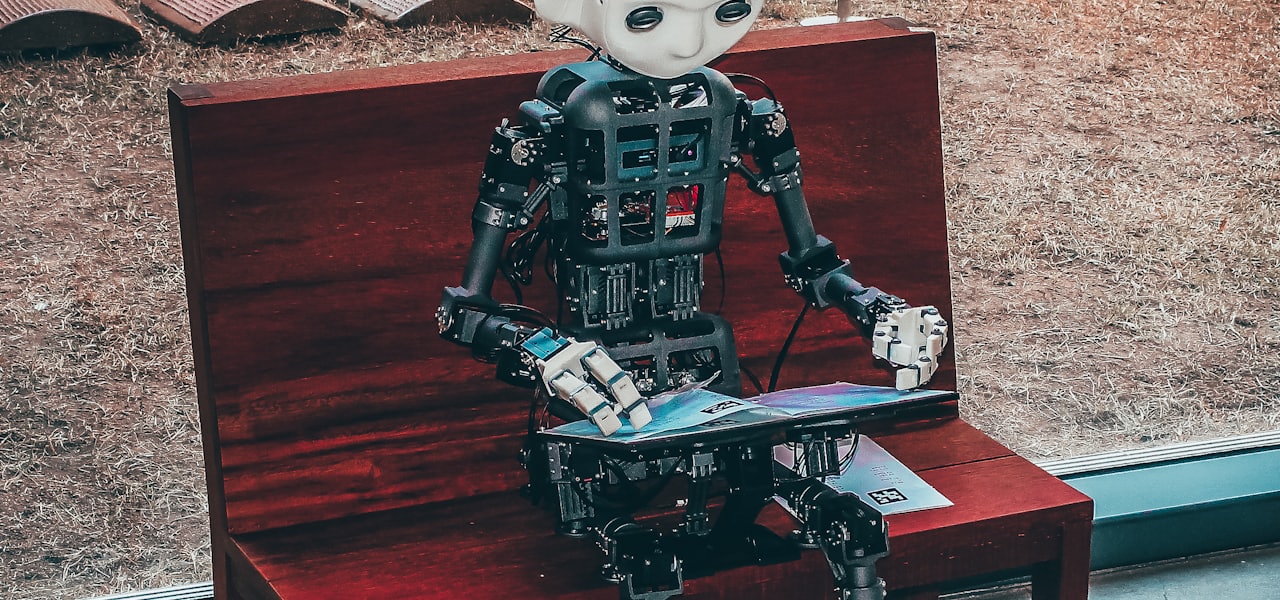
    Perceptual robotics is an interdisciplinary science linking Robotics and Neuroscience. It investigates biologically motivated robot control strategies, concentrating on perceptual rather than cognitive processes and thereby sides with J. J. Gibson's view against the Poverty of the stimulus theory. As a working definition, the following quote from Chapter 64 by H. Bülthoff, C. Wallraven and M. Giese from The Springer Handbook of Robotics, edited by Bruno Siciliano and Oussama Khatib, published by Springer in 2007, could be used: In the following we will apply the term Perceptual Robotics to signify the design of robots based on principles that are derived from human perception on all three levels in the sense of Marr. This includes a realization in terms of specific neural circuits as well as the transfer of more abstract biologically-inspired strategies for the solution of relevant computational problems.

    Read more →
  • COVID-19 apps

    COVID-19 apps

    COVID-19 apps include mobile-software applications for digital contact-tracing—i.e. the process of identifying persons ("contacts") who may have been in contact with an infected individual—deployed during the COVID-19 pandemic. Numerous tracing applications have been developed or proposed, with official government support in some territories and jurisdictions. Several frameworks for building contact-tracing apps have been developed. Privacy concerns have been raised, especially about systems that are based on tracking the geographical location of app users. Less overtly intrusive alternatives include the co-option of Bluetooth signals to log a user's proximity to other cellphones. (Bluetooth technology has form in tracking cell-phones' locations.)) On 10 April 2020, Google and Apple jointly announced that they would integrate functionality to support such Bluetooth-based apps directly into their Android and iOS operating systems. India's COVID-19 tracking app Aarogya Setu became the world's fastest growing application—beating Pokémon Go—with 50 million users in the first 13 days of its release. == Rationale == Contact tracing is an important tool in infectious disease control, but as the number of cases rises time constraints make it more challenging to effectively control transmission. Digital contact tracing, especially if widely deployed, may be more effective than traditional methods of contact tracing. In a March 2020 model by the University of Oxford Big Data Institute's Christophe Fraser's team, a coronavirus outbreak in a city of one million people is halted if 80% of all smartphone users take part in a tracking system; in the model, the elderly are still expected to self-isolate en masse, but individuals who are neither symptomatic nor elderly are exempt from isolation unless they receive an alert that they are at risk of carrying the disease. Some proponents advocate for legislation exempting certain COVID-19 apps from general privacy restrictions. == Issues == === Uptake === Ross Anderson, professor of security engineering at Cambridge University, listed a number of potential practical problems with app-based systems, including false positives and the potential lack of effectiveness if takeup of the app is limited to only a small fraction of the population. In Singapore, only one person in three had downloaded the TraceTogether app by the end of June 2020, despite legal requirements for most workers; the app was also underused, as it required users to keep it open at all times on iOS. A team at the University of Oxford simulated the effect of a contact tracing app on a city of 1 million. They estimated that if the app was used in conjunction with the shielding of over-70s, then 56% of the population would have to be using the app for it to suppress the virus. This would be equivalent to 80% of smartphone users in the United Kingdom. They found that the app could still slow the spread of the virus if fewer people downloaded it, with one infection being prevented for every one or two users. In August 2020, the American Civil Liberties Union (ACLU) argued that there were disparities in smartphone use between demographics and minority groups, and that "even the most comprehensive, all-seeing contact tracing system is of little use without social and medical systems in place to help those who may have the virus — including access to medical care, testing, and support for those who are quarantined." === App store restrictions === Addressing concerns about the spread of misleading or harmful apps, Apple, Google and Amazon set limits on which types of organizations could add coronavirus-related apps to its App Store, limiting them to only "official" or otherwise reputable organizations. === Ethical principles of mass surveillance using COVID-19 contact tracing apps === The advent of COVID-19 contact tracing apps has led to concerns around privacy, the rights of app users, and governmental authority. The European Convention on Human Rights, the International Covenant on Civil and Political Rights (ICCPR) and the United Nations and the Siracusa Principles have outlined 4 principles to consider when looking at the ethical principles of mass surveillance with COVID-19 contact tracing apps. These are necessity, proportionality, scientific validity, and time boundedness. Necessity is defined as the idea that governments should only interfere with a person's rights when deemed essential for public health interests. The potential risks associated with infringements of personal privacy must be outweighed by the possibility of reducing significant harm to others. Potential benefits of contact-tracing apps that may be considered include allowing for blanket population-level quarantine measures to be lifted sooner and the minimization of people under quarantine. Hence, some contend that contact-tracing apps are justified as they may be less intrusive than blanket quarantine measures. Furthermore, the delay of an effective contact-tracing app with significant health and economic benefits may be considered unethical. Proportionality refers to the concept that a contact tracing app's potential negative impact on a person's rights should be justifiable by the severity of the health risks that are being addressed. Apps must use the most privacy-preserving options available to achieve their goals, and the selected option should not only be a logical option for achieving the goal but also an effective one. Scientific validity evaluates whether an app is effective, timely and accurate. Traditional manual contact-tracing procedures are not efficient enough for the COVID-19 pandemic, and do not consider asymptomatic transmission. Contact-tracing apps, on the other hand, can be effective COVID-19 contact-tracing tools that reduce R value to less than 1, leading to sustained epidemic suppression. However, for apps to be effective, there needs to be a minimum 56-60% uptake in the population. Apps should be continually modified to reflect current knowledge on the diseases being monitored. Some argue that contact-tracing apps should be considered societal experimental trials where results and adverse effects are evaluated according to the stringent guidelines of social experiments. Analyses should be conducted by independent research bodies and published for wide dissemination. Despite the current urgency of our pandemic situation, we should still adhere to the standard rigors of scientific evaluation. Time boundedness describe the need for establishing legal and technical sunset clauses so that they are only allowed to operate as long as necessary to address the pandemic situation. Apps should be withdrawn as soon as possible after the end of the pandemic. If the end of the pandemic cannot be predicted, the use of apps should be regularly reviewed and decisions about continued use should be made at each review. Collected data should only be retained by public health authorities for research purposes with clear stipulations on how long the data will be held for and who will be responsible for security, oversight, and ownership. === Privacy, discrimination and marginalisation concerns === The American Civil Liberties Union (ACLU) has published a set of principles for technology-assisted contact tracing and Amnesty International and over 100 other organizations issued a statement calling for limits on this kind of surveillance. The organisations declared eight conditions on governmental projects: surveillance would have to be "lawful, necessary and proportionate"; extensions of monitoring and surveillance would have to have sunset clauses; the use of data would have to be limited to COVID-19 purposes; data security and anonymity would have to be protected and shown to be protected based on evidence; digital surveillance would have to address the risk of exacerbating discrimination and marginalisation; any sharing of data with third parties would have to be defined in law; there would have to be safeguards against abuse and the rights of citizens to respond to abuses; "meaningful participation" by all "relevant stakeholders" would be required, including that of public health experts and marginalised groups. The German Chaos Computer Club (CCC) and Reporters Without Borders also issued checklists. The Exposure Notification service intends to address the problem of persistent surveillance by removing the tracing mechanism from their device operating systems once it is no longer needed. On 20 April 2020, it was reported that over 300 academics had signed a statement favouring decentralised proximity tracing applications over centralised models, given the difficulty in precluding centralised options being used "to enable unwarranted discrimination and surveillance." In a centralised model, a central database records the ID codes of meetings between users. In a decentralised model, this information is recorded on individual phones, with the role of the central

    Read more →
  • Plotting algorithms for the Mandelbrot set

    Plotting algorithms for the Mandelbrot set

    There are many programs and algorithms used to plot the Mandelbrot set and other fractals, some of which are described in fractal-generating software. These programs use a variety of algorithms to determine the color of individual pixels efficiently. == Escape time algorithm == The simplest algorithm for generating a representation of the Mandelbrot set is known as the "escape time" algorithm. A repeating calculation is performed for each x, y point in the plot area and based on the behavior of that calculation, a color is chosen for that pixel. === Unoptimized naïve escape time algorithm === In both the unoptimized and optimized escape time algorithms, the x and y locations of each point are used as starting values in a repeating, or iterating calculation (described in detail below). The result of each iteration is used as the starting values for the next. The values are checked during each iteration to see whether they have reached a critical "escape" condition, or "bailout". If that condition is reached, the calculation is stopped, the pixel is drawn, and the next x, y point is examined. For some starting values, escape occurs quickly, after only a small number of iterations. For starting values very close to but not in the set, it may take hundreds or thousands of iterations to escape. For values within the Mandelbrot set, escape will never occur. The programmer or user must choose how many iterations–or how much "depth"–they wish to examine. The higher the maximal number of iterations, the more detail and subtlety emerge in the final image, but the longer time it will take to calculate the fractal image. Escape conditions can be simple or complex. Because no complex number with a real or imaginary part greater than 2 can be part of the set, a common bailout is to escape when either coefficient exceeds 2. A more computationally complex method that detects escapes sooner, is to compute distance from the origin using the Pythagorean theorem, i.e., to determine the absolute value, or modulus, of the complex number. If this value exceeds 2, or equivalently, when the sum of the squares of the real and imaginary parts exceed 4, the point has reached escape. More computationally intensive rendering variations include the Buddhabrot method, which finds escaping points and plots their iterated coordinates. The color of each point represents how quickly the values reached the escape point. Often black is used to show values that fail to escape before the iteration limit, and gradually brighter colors are used for points that escape. This gives a visual representation of how many cycles were required before reaching the escape condition. To render such an image, the region of the complex plane we are considering is subdivided into a certain number of pixels. To color any such pixel, let c {\displaystyle c} be the midpoint of that pixel. We now iterate the critical point 0 under P c {\displaystyle P_{c}} , checking at each step whether the orbit point has modulus larger than 2. When this is the case, we know that c {\displaystyle c} does not belong to the Mandelbrot set, and we color our pixel according to the number of iterations used to find out. Otherwise, we keep iterating up to a fixed number of steps, after which we decide that our parameter is "probably" in the Mandelbrot set, or at least very close to it, and color the pixel black. In pseudocode, this algorithm would look as follows. The algorithm does not use complex numbers and manually simulates complex-number operations using two real numbers, for those who do not have a complex data type. The program may be simplified if the programming language includes complex-data-type operations. for each pixel (Px, Py) on the screen do x0 := scaled x coordinate of pixel (scaled to lie in the Mandelbrot X scale (-2.00, 0.47)) y0 := scaled y coordinate of pixel (scaled to lie in the Mandelbrot Y scale (-1.12, 1.12)) x := 0.0 y := 0.0 iteration := 0 max_iteration := 1000 while (xx + yy ≤ 22 AND iteration < max_iteration) do xtemp := xx - yy + x0 y := 2xy + y0 x := xtemp iteration := iteration + 1 color := palette[iteration] plot(Px, Py, color) Here, relating the pseudocode to c {\displaystyle c} , z {\displaystyle z} and P c {\displaystyle P_{c}} : z = x + i y {\displaystyle z=x+iy\ } z 2 = x 2 + 2 i x y {\displaystyle z^{2}=x^{2}+2ixy} - y 2 {\displaystyle y^{2}\ } c = x 0 + i y 0 {\displaystyle c=x_{0}+iy_{0}\ } and so, as can be seen in the pseudocode in the computation of x and y: x = R e ⁡ ( z 2 + c ) = x 2 − y 2 + x 0 {\displaystyle x=\mathop {\mathrm {Re} } (z^{2}+c)=x^{2}-y^{2}+x_{0}} and y = I m ⁡ ( z 2 + c ) = 2 x y + y 0 . {\displaystyle y=\mathop {\mathrm {Im} } (z^{2}+c)=2xy+y_{0}.\ } To get colorful images of the set, the assignment of a color to each value of the number of executed iterations can be made using one of a variety of functions (linear, exponential, etc.). One practical way, without slowing down calculations, is to use the number of executed iterations as an entry to a palette initialized at startup. If the color table has, for instance, 500 entries, then the color selection is n mod 500, where n is the number of iterations. === Optimized escape time algorithms === The code in the previous section uses an unoptimized inner while loop for clarity. In the unoptimized version, one must perform five multiplications per iteration. To reduce the number of multiplications the following code for the inner while loop may be used instead: x2:= 0 y2:= 0 w:= 0 while (x2 + y2 ≤ 4 and iteration < max_iteration) do x:= x2 - y2 + x0 y:= w - x2 - y2 + y0 x2:= x x y2:= y y w:= (x + y) (x + y) iteration:= iteration + 1 The above code works via some algebraic simplification of the complex multiplication: ( i y + x ) 2 = − y 2 + 2 i y x + x 2 = x 2 − y 2 + 2 i y x {\displaystyle {\begin{aligned}(iy+x)^{2}&=-y^{2}+2iyx+x^{2}\\&=x^{2}-y^{2}+2iyx\end{aligned}}} Using the above identity, the number of multiplications can be reduced to three instead of five. The above inner while loop can be further optimized by expanding w to w = x 2 + 2 x y + y 2 {\displaystyle w=x^{2}+2xy+y^{2}} Substituting w into y = w − x 2 − y 2 + y 0 {\displaystyle y=w-x^{2}-y^{2}+y_{0}} yields y = 2 x y + y 0 {\displaystyle y=2xy+y_{0}} and hence calculating w is no longer needed. The further optimized pseudocode for the above is: x:= 0 y:= 0 x2:= 0 y2:= 0 while (x2 + y2 ≤ 4 and iteration < max_iteration) do x2:= x x y2:= y y y:= 2 x y + y0 x:= x2 - y2 + x0 iteration:= iteration + 1 Note that in the above pseudocode, 2 x y {\displaystyle 2xy} seems to increase the number of multiplications by 1, but since 2 is the multiplier the code can be optimized via ( x + x ) y {\displaystyle (x+x)y} . == Coloring algorithms == In addition to plotting the set, a variety of algorithms have been developed to efficiently color the set in an aesthetically pleasing way show structures of the data (scientific visualisation) === Histogram coloring === A more complex coloring method involves using a histogram which pairs each pixel with said pixel's maximum iteration count before escape/bailout. This method will equally distribute colors to the same overall area, and, importantly, is independent of the maximum number of iterations chosen. This algorithm has four passes. The first pass involves calculating the iteration counts associated with each pixel (but without any pixels being plotted). These are stored in an array IterationCounts[x][y], where x and y are the x and y coordinates of said pixel on the screen respectively. The first step of the second pass is to create an array NumIterationsPerPixel[n], where the array size n is the maximum iteration count. Next, one must iterate over the array of pixel-iteration count pairs IterationCounts[x][y], and retrieve each pixel's saved iteration count, i, via e.g. i = IterationCounts[x][y]. After each pixel's iteration count i is retrieved, it is necessary to index the NumIterationsPerPixel array at i and increment the indexed value (which is initially zero) -- e.g. NumIterationsPerPixel[i] = NumIterationsPerPixel[i] + 1. for (x = 0; x < width; x++) do for (y = 0; y < height; y++) do i:= IterationCounts[x][y] NumIterationsPerPixel[i]++ The third pass iterates through the NumIterationsPerPixel array and adds up all the stored values, saving them in total. The array index represents the number of pixels that reached that iteration count before bailout. total: = 0 for (i = 0; i < max_iterations; i++) do total += NumIterationsPerPixel[i] After this, the fourth pass begins and all the values in the IterationCounts array are indexed, and, for each iteration count i, associated with each pixel, the count is added to a global sum of all the iteration counts from 1 to i in the NumIterationsPerPixel array . This value is then normalized by dividing the sum by the total value computed earlier. hue[][]:= 0.0 for (x = 0; x < width; x++) do for (y = 0; y < height; y++) do iteration:= Iteration

    Read more →
  • Bin picking

    Bin picking

    Bin picking (also referred to as random bin picking) is a core problem in computer vision and robotics. The goal is to have a robot with sensors and cameras attached to it pick-up known objects with random poses out of a bin using a suction gripper, parallel gripper, or other kind of robot end effector. Early work on bin picking made use of Photometric Stereo in recovering the shapes of objects and to determine their orientation in space. Amazon previously held a competition focused on bin picking referred to as the "Amazon Picking Challenge", which was held from 2015 to 2017. The challenge tasked entrants with building their own robot hardware and software that could attempt simplified versions of the general task of picking and stowing items on shelves. The robots were scored by how many items were picked and stowed in a fixed amount of time. The first Amazon Robotics challenge was won by a team from TU Berlin in 2015, followed by a team from TU Delft and the Dutch company "Fizyr" in 2016. The last Amazon Robotics Challenge was won by the Australian Centre for Robotic Vision at Queensland University of Technology with their robot named Cartman. The Amazon Robotics/Picking Challenge was discontinued following the 2017 competition. Although there can be some overlap, bin picking is distinct from "each picking" and the bin packing problem.

    Read more →